

| Date | Wednesday, September 30, 2026 |
|---|---|
| Venue | Ohtemachi Mitsui Hall |
| Participants | Approximately 160 participants (approximately 60 from nuclear operators, approximately 10 from the Nuclear Regulation Authority, and participants from manufacturers, general contractors, universities, and other organizations) |
 |
 |
Program 
*Except for the Keynote Report, the videos feature Japanese audio only.
Opening Session
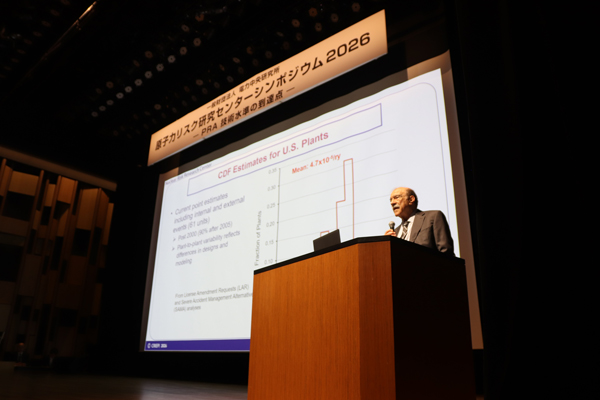
As an introduction to the symposium, NRRC Director George Apostolakis delivered a keynote report entitled “Observations on Probabilistic Risk Assessment (PRA) and Its Impact on Reactor Safety.” He expressed the view that what might be called a “10⁻⁶ culture” had existed in Japan: an approach that places emphasis on whether PRA results fall below a specific numerical value (10⁻⁶), with insufficient discussion of the relative magnitude of risks and which improvements should be prioritized. He also noted the importance of examining how to assess the risk of an entire nuclear power station with multiple units and reflect the assessment in decision-making in relation to safety goals.
He also explained the benefits of risk-informed decision-making (RIDM), noting that the introduction of various RIDM programs in the United States, including the Maintenance Rule, has not only increased nuclear power plant capacity factors but also improved safety: the core damage frequency estimated by internal events PRA has decreased to approximately one-twentieth of its level in the 1990s.
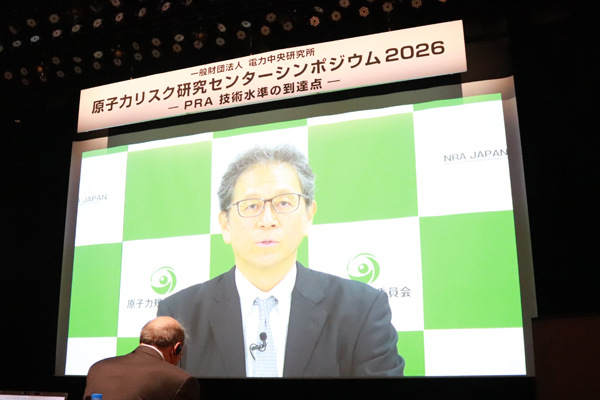
Next, Mr. Toshiyuki Koganeya, Director-General for Nuclear Material and Radiation, Secretariat of the Nuclear Regulation Authority, delivered a prerecorded keynote lecture entitled “Risk-Informed Nuclear Regulation — Toward Effective and Efficient Regulatory Activities.” In addition to explaining the use of risk information in regulatory activities to date, exchanges of views with industry on the use of risk information, and the status of the introduction of on-line maintenance (OLM), he discussed the expansion toward full-scope PRA (the gradual expansion of hazards covered by PRA, including internal fire and internal flooding) and the importance of research and development by both the regulator and the industry to support this expansion.
Keynote Report (George Apostolakis, Director, NRRC)


Keynote Lecture (Toshiyuki Koganeya, Director-General for Radiation Protection Strategy
and Security, Nuclear Regulation Authority)
Overview of PRA and RIDM in Japan
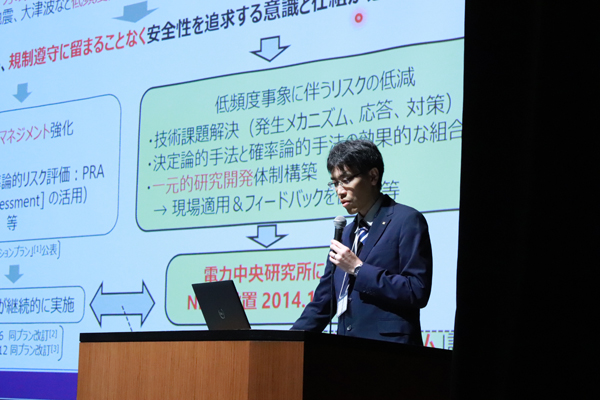
In advance of the research presentations in the “Present Stage of Achievement” and “Future Research and Development” sessions, Deputy Director Junya Tanigawa presented an “Overview of PRA Method Development and RIDM in Japan,” providing the background for those presentations.
Present Stage of Achievement
(1) Support for Improving the Quality of Internal Events PRA Models
Yusuke Arai, Research Scientist of the RIDM Promotion Team, reported that industry efforts, including NRRC, in the area of internal events PRA. The efforts have brought internal events PRA models, including assessments of component failure rates and human errors, up to international technical standards, enabling risk information to be used in a wide range of applications.
The following major NRRC initiatives that contributed to this progress were reported.
- Overseas Experts Peer Review of Internal Event PRA
- Improvements in Methods for Collecting and Analyzing Data on Component Failure Rates
- Development of HRA Qualitative Analysis Guide
(2) Seismic PRA Methodology Development and Plant Applications
Masato Nakajima, Head of the External Natural Event Research Team, reported that industry efforts, including NRRC, in the area of seismic PRA. Seismic PRA has reached a level capable of supporting the use of risk information by reducing conservatism in assessment methods and seismic PRA models and further improving their explainability, taking into account the site characteristics of each nuclear power plant.
The following major NRRC initiatives that contributed to this progress were reported.
- Seismic Hazard Assessment Method Improvement and Development Based on Ikata SSHAC Project
- Development of More Realistic Seismic Fragility Assessment Methods
(3) Tsunami PRA Methodology Development and Plant Applications
Naoto Kihara, Deputy Head of the External Natural Event Research Team, reported that industry efforts, including NRRC, in the area of tsunami PRA. It is possible to perform Level 1 through Level 2 tsunami PRA that provides more realistic risk assessments. This has been achieved by identifying detailed accident scenarios that consider characteristics such as inundation within the site and inside buildings, taking into account the site characteristics of each nuclear power plant.
The following major NRRC initiatives that contributed to this progress were reported.
- Proposal of Method Capable of Considering Site Characteristics to Evaluate Site Inundation
- Tsunami PRA Conducted of Realistic Accident Scenarios
(4) Internal Fire PRA Methodology and Flooding PRA Methodology Development and Plant Applications
Motomu Suzuki, Senior Research Scientist of the Risk Assessment Research Team, reported that industry efforts, including NRRC, in the area of internal fire PRA are establishing a framework for effectively and efficiently performing high-quality internal fire PRA that reflects the conditions of individual plants. At the same time, he identified the enormous resources required to perform these assessments as a challenge. The following NRRC initiatives that contributed to this progress were reported.
- PRA Implementation Guide Development
- Generic Fire Ignition Frequency Distribution Compilation
- Development of Assessment Methods Required for PRA
- Actual Plant Data Evaluations
Next, industry efforts, including NRRC, in the area of internal flooding PRA was reported. It is now possible to effectively and efficiently perform high-quality internal flooding PRA that reflects the conditions of individual plants.
The following NRRC initiatives that contributed to this progress were reported.
- Actual Plant Data Evaluations for Guide Development
- Development of Assessment Methods Required for PRA
- Drafting of PRA Implementation Guide
(5) Level 2 PRA Methodology Development and Plant Applications
Koichi Nakamura, Senior Research Scientist of the Risk Assessment Research Team, reported that industry efforts, including NRRC, in the area of Level 2 PRA. We have confirmed that conservatism in assessments is reduced compared with previous approaches, and that a path toward obtaining best estimates in Level 2 PRA has been established.
The following NRRC initiatives that contributed to this progress were reported.
- Incorporation of Containment Fragility into Containment Failure Frequency Evaluation
- Establishment of Evaluation Method Removing Particle Materials in Containment Leak
- Benchmarking of Developed Methods
(6) Development and Utilization of RIDM Guide
Manabu Watanabe, Head of the RIDM Promotion Team, reported that NRRC’s development of guidelines for on-line maintenance has led the Nuclear Regulation Authority to agree to its introduction, and that implementation is expected to become possible following amendments to the relevant internal rules, marking progress in the use of risk information in Japan. He also reported the outlook that knowledge of specific RIDM methods developed through NRRC’s past work, such as extending the intervals between containment leakage rate tests, is expected to be applied in practice.
Future Research and Development
(1) Development of Tornado PRA Methodology and Volcano PRA Methodology
Daisuke Nohara and Kiyoshi Doshida, Senior Research Scientist of the External Natural Event Research Team, reported that, for both tornado PRA and volcanic PRA, NRRC is currently accelerating development from hazard assessment through PRA modeling, and that NRRC will also begin developing fragility assessment methods. They also reported plans to use these methods to develop PRA methodologies that take plant characteristics into account and to prepare documents, including guidelines, to support PRA implementation at actual plants.
(2) Development of Methodologies for Full-Scope PRA
Kimitoshi Yoneda, Research Coordinator, reported on NRRC’s efforts to date on multi-hazard PRA, multi-unit PRA, PRA for spent fuel pools and pits, and Level 3 PRA, with the aim of establishing assessment methods for full-scope PRA. For PRAs whose implementation requirements are specified in academic society standards and related documents, practical methods and methods suited to conditions in Japan are being developed. He also reported that, for PRAs for which methods have already been developed to a certain extent, methods enabling more realistic assessments are being developed.
Closing Session
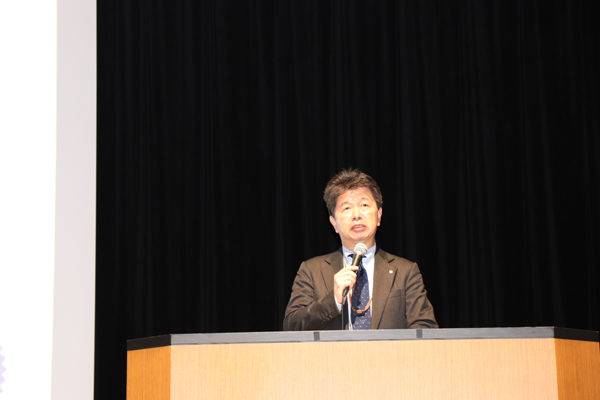
In his closing remarks, Yoshiyuki Asaoka, Acting Director, expressed his gratitude to the speakers and participants and emphasized that the key issue going forward is how to use the risk information obtained to improve safety.
Content published on this website (including text, figures, tables, photographs, and videos) may not be modified, adapted, reproduced, republished, transmitted, made available for transmission, transferred, or used to create derivative works without permission from CRIEPI, except where permitted under copyright law, such as reproduction for private use or quotation.
