
Overview
Key features of FERMAT
GUI(Graphical User Interface)
FERMAT runs on standard Windows PCs and allows users to completer the entire process—from input preparation to analysis execution—within an intuitive GUI. Accurately calculating failure probability requires detailed information about the target component, and creating input files can be a time–consuming task for users. FERMAT reduces this burden through its user–friendly GUI.
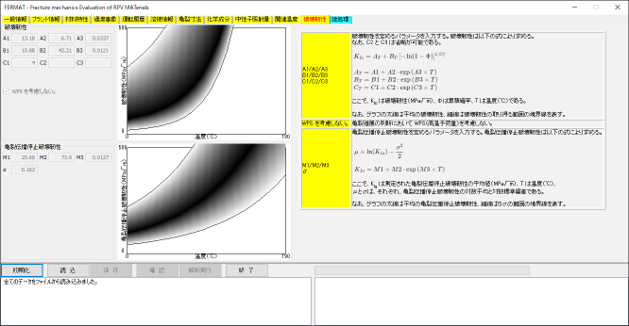
Display of Analysis results
FERMAT outputs its results as Excel files (.xlsx). Each output file organizes both input data and analysis results, allowing users to visually confirm what inputs were used, how the analysis was performed, and what results were obtained. Since numerical data are displayed in the Excel file, users can easily copy portions of the analysis results into their own Excel sheets for further evaluation.
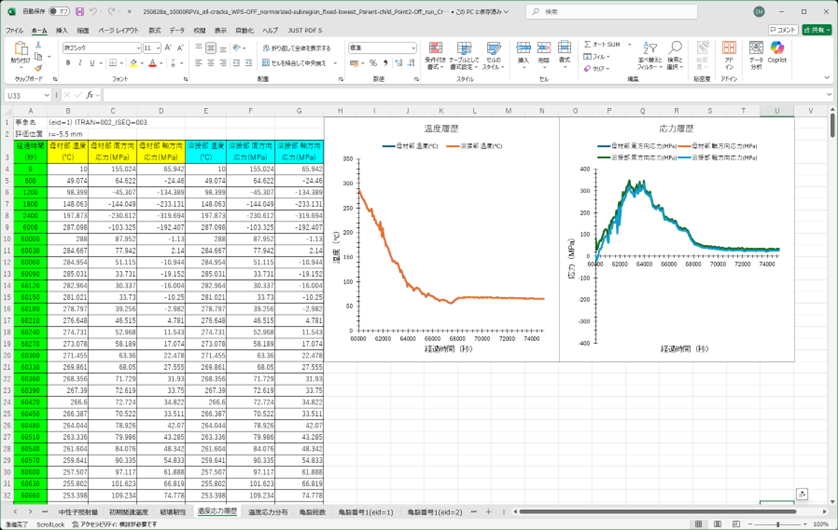
Example of FERMAT output in Excel spreadsheet format
Analysis Target of FERMAT
Pressurize Thermal Shock (PTS)
When the emergency core cooling system (ECCS) is activated during an accident, the reactor pressure vessel (RPV) is cooled, resulting in a significant temperature gradient across the vessel wall, between its inner and outer surfaces. This results in high thermal stresses, which are further superimposed on membrane stresses caused by internal pressure, generating substantial tensile stresses on the inner surface of the RPV. Such an event is referred to as a Pressurized Thermal Shock (PTS).
According to the Japanese standard JEAC-4206–2016 [1], an assumed crack is placed near the inner surface of the RPV in pressurized water reactors (PWRs), and it must be verified that the primary coolant retention function is adequately maintained even under PTS. Meanwhile, the Japanese guideline JEAG4640–2018 [2] provides guidelines for evaluating the failure frequency of RPVs using probabilistic fracture mechanics (PFM), with detailed recommendations specifically for PTS events in Pressurized Water Reactors (PWRs). FERMAT performs PFM analysis in accordance with the guidelines.
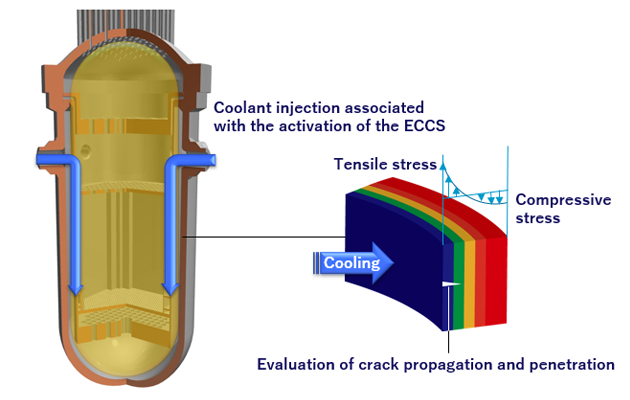
Schematic diagram of the PTS
- [1] Japan Electric Association, “Verification Method of Fracture Toughness for In–Service Reactor Pressure Vessel”, JEAC 4206–2016.
- [2] Japan Electric Association, “Guideline for Calculating Failure Frequency of Reactor Pressure Vessel Based on Probabilistic Fracture Mechanics”, JEAG 4640–2018.
Expansion of Target Event Scope
FERMAT is currently being enhanced to support analyses of events other than PTS events in Pressurized Water Reactors (PWRs).
Future updates will include capabilities for analyzing other scenarios, particularly those anticipated in Boiling Water Reactors (BWRs).
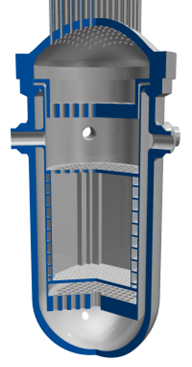
Pressure vessel in a PWR
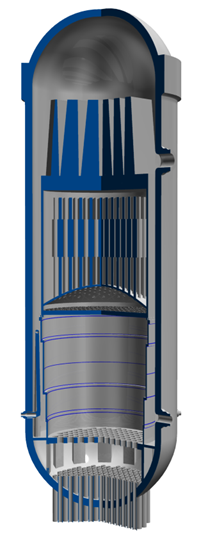
Reactor pressure vessel in a BWR